

 24Hotline:18962699833
How to choose an appropriate automatic sandblasting machine for surface treatment of glass products?
Complete selection guide of automatic sandblasting machine for surface treatment of glass products
Glass is brittle and fragile, and the core pain point of sandblasting is to avoid edge explosion, chipping, uneven sand surface and scratches. The selection should be matched according to five steps: "workpiece shape → productivity → process effect → special equipment configuration → environmental protection and safety". The following is a description of the scene, parameters and configuration one by one.
1. Step 1: Determine the type of aircraft according to the glass shape (the core selection basis).
1. Flat glass (float glass, mirror, door and window glass, tempered panel, photovoltaic cover plate)
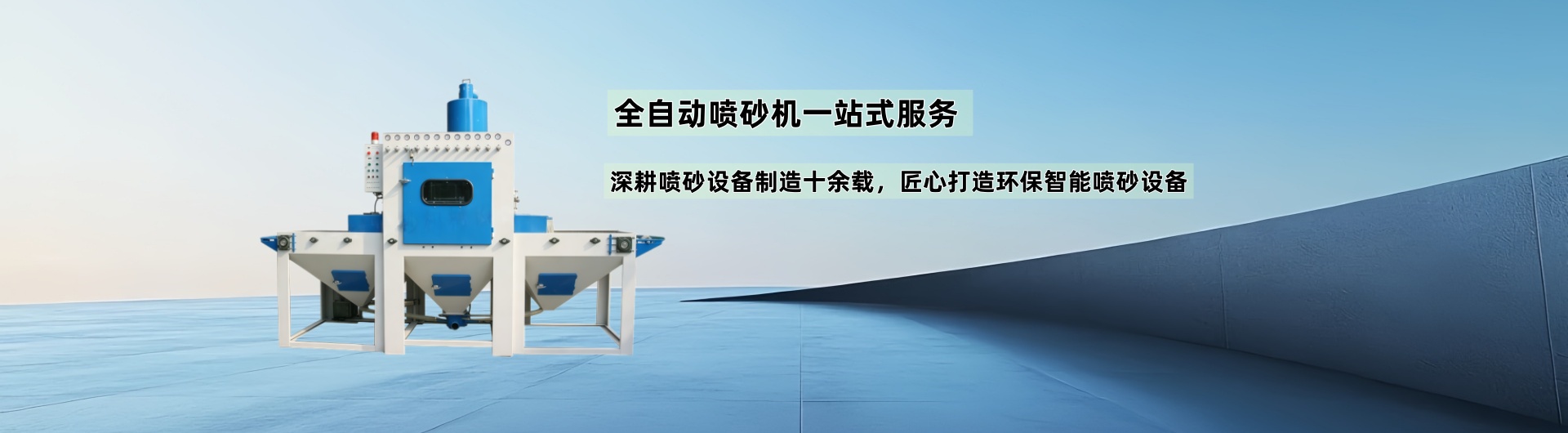
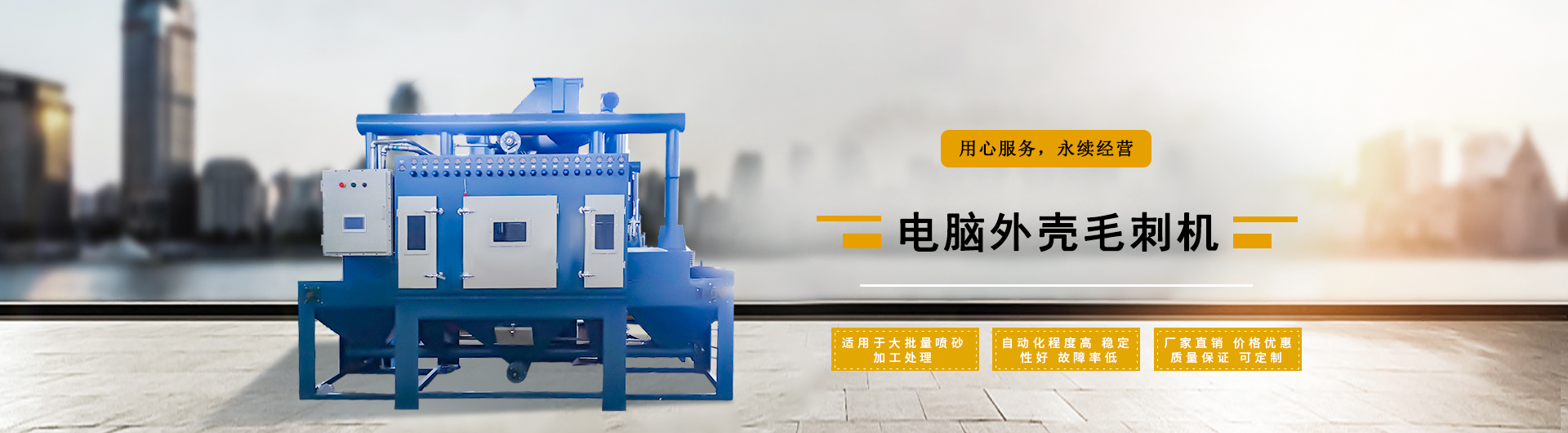
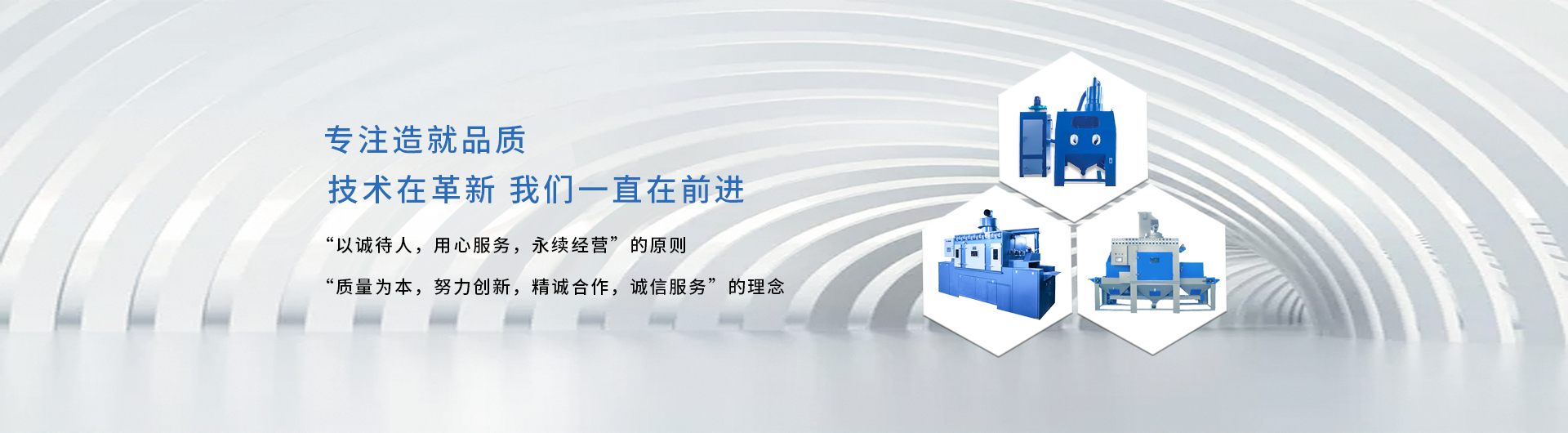
First choice: belt conveyor automatic sandblasting machine (the same model in your picture)
Adaptation scenario: continuous production line of mass standard flat plates, flat plates with thickness of 2–19 mm and fixed plates with length and width.
Core advantages:
Tunnel-type fully enclosed, belt feeding at a constant speed, full coverage of upper and lower swing spray guns, no negative and positive sand surface, no leakage spray;
The conveying speed is 0.3–5m/min, with stepless frequency conversion, low speed for thin glass and high speed for thick glass;
Can be docked with cleaning, drying and coating production lines to realize fully automatic unmanned operation;
The bottom hopper automatically recovers sand, which is suitable for 24-hour mass production.
Adaptive capacity: the daily output is more than 500㎡, and building glass, bathroom mirror and home appliance panel are preferred.
2. Special-shaped/curved glass (curved glass in shower room, artistic carved glass, hollow special-shaped parts and small ornaments)
Scheme 1: Rotary automatic sandblasting machine (small batch of three-dimensional special shape)
Workpiece revolution+rotation, multi-angle swing spray gun, covering curved surfaces and corners, suitable for bending glass of dozens of small pieces in a single batch; Disadvantages are intermittent production and low productivity.
Scheme 2: Non-standard customized pass type (large quantities of curved glass)
Customized arc tooling roller and adjustable angle spray gun group, continuous conveying, suitable for mass production of curved glass in shower room.
Scheme 3: semi-automatic box-type automatic sandblasting machine (proofing, small batch customization of glass)
The manipulator swings the spray gun, loads and unloads materials manually, and switches various special-shaped styles flexibly, which is suitable for art glass shops and proofing workshops.
3. Ultra-thin glass (≤2mm electronic cover and display glass)
Priority wet liquid automatic sandblasting machine
Water+abrasive mixed injection, soft impact, no corner collapse and micro-cracks caused by high-speed impact of dry sand; The dust is almost zero, which is suitable for fine matte treatment of high-end electronic glass.
2. Step 2: Match the equipment pressure, spray gun and sand road configuration according to the surface process effect.
Glass sandblasting can be divided into fine grinding, moderate matte, deep etching and roughening before coating, and the equipment parameters must be distinguished:
1. Fine soft light/decorative matte (bathroom mirror, decorative glass, delicate and scratch-free)
Working pressure: 0.2–0.3MPa (low-pressure system), and it is strictly prohibited to exceed 0.3 MPa to prevent glass from cracking and edge explosion.
Spray gun configuration: several small-caliber tungsten steel low-pressure spray guns swing back and forth at a constant speed, and the spraying distance is fixed at 200-300mm.
Abrasive adaptation: 80-120 mesh glass beads (spherical without edges and corners, which will not scratch the glass), and the equipment needs to be equipped with a fine sand separation and recovery system.
Equipment requirements: independent pressure regulating valve, and the air pressure of each spray gun can be adjusted independently to avoid excessive local impact.
2. Moderate matte/anti-glare (doors and windows, partition glass)
Air pressure: 0.25–0.35 MPa, 60–80 mesh glass beads/fine white corundum.
The upper and lower double-layer layout of the spray gun ensures the uniform sand surface on the front and back edges of the plate.
3. Deep etching/LOGO pattern carving (art glass, logo glass)
The upper limit of air pressure is 0.35MPa, and it is equipped with a high-flow pressure-in sandblasting system.
The equipment should support the positioning of shielding film tooling, and the stroke of the spray gun should be accurately controlled to prevent the rough edges of the pattern.
4. Roughening before coating/painting (improving coating adhesion)
Air pressure 0.3-0.38MPa, 60 mesh white corundum; Pre-dedusting and post-blowing stations are added to the equipment, and the floating sand on the surface is automatically cleaned after sandblasting.
Third, the third step: the exclusive structural configuration that the glass sandblasting machine must have (the key to avoiding pits)
1. Transport protection system (to prevent glass from being scratched and broken)
Conveyor belt: wear-resistant silicone/thickened rubber belt, and it is forbidden for metal chain plates to contact glass directly; The surface of the belt is flat and free from hard bumps, and the side edge is provided with flexible blocking strips to prevent the glass from sliding and bumping.
Roller/support: Buffer rubber support is added at the bottom of the plate, and the support spacing is widened by thick glass to avoid falling and breaking in the middle of transportation.
Limit: soft rubber anti-collision buffer blocks are installed at the inlet and outlet to prevent the upper and lower materials from hitting the corner.
2. Sand circulation and anti-blocking system (glass dust is fine, which is easy to block the gun)
Multi-stage separation and recovery: cyclone separation+vibrating screen double-layer filtration, separating glass dust and broken fine sand, and only circulating complete abrasive; Fine dust is collected separately to avoid scratches caused by repeated impact on the glass.
Large-diameter sand pipe and anti-blocking spray gun: glass dust has high viscosity, and ordinary fine sand pipes are easily blocked, so the sand road must be widened, and the spray gun has built-in anti-blocking diversion structure.
Multi-bucket aggregate at the bottom: as shown in the figure, the equipment is a three-stage hopper, which can quickly recover the falling sand and reduce the dust suspension and scratch the glass twice.
3. Dust removal and sealing (glass micro-dust is harmful, and environmental protection is mandatory)
The whole machine is fully sealed with sandblasting cabin, double-layer observation window and wear rubber sealing strip to prevent dust from overflowing.
Two-stage pulse dust removal: the coarse sand is intercepted by primary filtration, and the ultra-fine glass dust is filtered by high-precision filter element, and the discharge meets the workshop environmental protection standards; Wet machine directly eliminates dust.
LED explosion-proof lighting in the cabin is convenient for observing the uniformity of sand surface without opening the door.
4. Electrical and safety protection (exclusive protection of glass brittle materials)
Independent low-pressure pneumatic system: air compressor voltage stabilizing module, air pressure fluctuation ≤±0.02MPa, to prevent instantaneous high pressure from breaking glass.
Emergency stop, overload and belt deviation protection: glass jam will automatically stop and give an alarm to avoid extrusion and fragmentation.
Anti-static grounding: glass friction is easy to generate electrostatic dust adsorption, the whole machine, conveyor belt and dust removal box are all reliably grounded, and the humidity control module is selected (the workshop humidity is 40%–60% is the best).
4. Step 4: Screen the model specifications according to the production capacity and workshop conditions.
Small batch (daily production capacity < 300m2, multi-specification special-shaped glass)
Selection: semi-automatic manipulator box sandblasting machine, with small floor space, low investment and flexible change of funds; Suitable for artistic glass and proofing processing.
Medium batch (daily production capacity of 300–1000m2, standard flat glass)
Selection: standard 1200/1600 wide conveyor automatic sandblasting machine (as shown in the picture), 6-10 swing spray guns, stable mass production in a single shift.
Mass production line (daily production capacity > 1000m2, curtain wall, photovoltaic, mirror factory)
Selection: widen 1800-2200mm double-channel conveying sandblasting machine, with upper and lower double-layer spray gun groups, which can be connected with cleaning and tempering production lines and equipped with automatic loading and unloading machines.
Strict dust control in the workshop, food/medical glass
Direct wet liquid automatic sandblasting machine has no dust pollution, finer sand surface and no hidden danger of glass microcracks.
V. Step 5: Selection of Pit Avoidance and Acceptance Criteria
Common mistakes in type selection
General high-pressure sandblasting machine for metal and hardware is selected: the air pressure is 0.4-0.8MPa, which easily leads to dark cracking of glass and later self-explosion; Special glass models must be customized at low pressure.
Separation of unworked sand materials: recycling of broken fine sand will produce dense scratches on the glass surface, and the rejection rate will soar.
Metal conveyor belt has no silica gel buffer: the original glass sheet is scratched during transportation, and the subsequent coating appears defects.
Simple dust removal: glass dust floats out of the workshop, which is a punishment for environmental protection, and the risk of occupational diseases for workers is high.
