

 24Hotline:18962699833
What type of automatic sandblasting machine is suitable for surface treatment of automobile parts?
Automatic sandblasting machine is selected for surface treatment of automobile parts, and the core is "matching equipment according to parts types and processing requirements", giving priority to efficiency, processing uniformity and workpiece protection. The following suggestions are given:
First, mainstream adaptation models and applicable scenarios
1. Crawler automatic sandblasting machine (universal model recommended)
Applicable parts: small stamping parts (such as buckles and gaskets), fasteners (bolts and nuts) and small-sized castings (such as sensor housings).
Core advantages: high batch processing efficiency, workpiece tumbling with crawler, uniform sandblasting without dead angle; Compatible with a variety of abrasives, suitable for basic needs such as rust removal, descaling and surface roughening.
Key adaptation point: it is suitable for small and medium-sized parts without precision structure and not afraid of collision, and the processing cost is low.
2. Rotary automatic sandblasting machine (precision model recommended)
Applicable parts: engine block/cylinder head, gearbox housing, hub, precision gear and other parts with complex structure or high precision requirements.
Core advantages: the workpiece is fixed on the turntable, and the nozzle accurately sandblasts according to the preset path, so as to avoid leakage in complex cavities, threaded holes and other areas; Sandblasting pressure and angle can be adjusted to protect the precise surface from damage.
Key adaptation point: suitable for parts that need local strengthening, accurate deburring or deformation avoidance, with high processing accuracy.
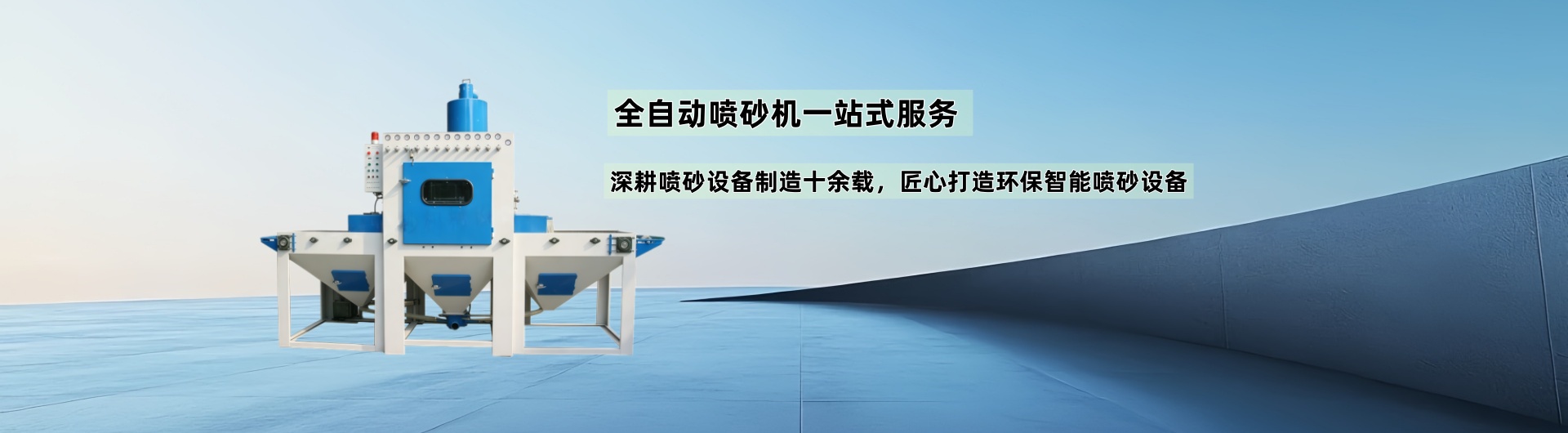
3. Conveying automatic sandblasting machine (recommended for large/long parts)
Applicable parts: body frame, chassis parts (such as swing arm, cross beam), exhaust pipe, long shaft parts (such as transmission shaft).
Core advantages: continuous feeding through conveyor belt, simultaneous sandblasting with multiple groups of nozzles, and suitable for batch processing of large and long parts; High degree of automation, continuous operation can be realized by docking production line.
Key adaptation point: suitable for parts with large size that cannot be rolled in batches, giving consideration to efficiency and consistency.
4. High-pressure automatic sandblasting machine (recommended for intensified/heavy oil pollution)
Applicable parts: brake discs, brake pads, suspension springs and other parts that need surface strengthening (improving hardness and fatigue strength) or removing heavy oil stains and thick scales.
Core advantages: higher sandblasting pressure (0.6-0.8MPa), strong abrasive impact, rapid removal of stubborn impurities and surface grain refinement; It can be matched with high-strength abrasives such as silicon carbide and corundum.
Key adaptation point: it is necessary to control the pressure to avoid deformation of thin-walled parts.
Second, the selection of core considerations
Material of parts: steel/iron parts can be made of high-pressure or crawler type, and aluminum alloy and plastic (such as interior bracket) need to be made of low-pressure turntable to avoid material damage.
Processing requirements: crawler type is selected for foundation cleaning (rust removal and deburring); Finishing after precision machining and locally strengthening the rotary table; Large-scale parts are produced in batches by conveying type; High pressure type is selected for surface strengthening.
Production scale: small and medium-sized crawler can be selected for small batch trial production, and conveyor or multi-station turntable is needed for large batch production line to improve production capacity.
